Whew, TH01's boss code just had to end with another beast of a boss, taking
way longer than it should have and leaving uncomfortably little time for the
rest of the game. Let's get right into the overview of YuugenMagan, the most
sequential and scripted battle in this game:
The fight consists of 14 phases, numbered (of course) from 0 to 13.
Unlike all other bosses, the "entrance phase" 0 is a proper gameplay-enabled
part of the fight itself, which is why I also count it here.
YuugenMagan starts with 16 HP, second only to Sariel's 18+6. The HP bar
visualizes the HP threshold for the end of phases 3 (white part) and 7
(red-white part), respectively.
All even-numbered phases change the color of the 邪 kanji in the stage
background, and don't check for collisions between the Orb and any eye.
Almost all of them consequently don't feature an attack, except for phase
0's 1-pixel lasers, spawning symmetrically from the left and right edges of
the playfield towards the center. Which means that yes, YuugenMagan is in
fact invincible during this first attack.
All other attacks are part of the odd-numbered phases:
Phase 1: Slow pellets from the lateral eyes. Ends
at 15 HP.
Phase 3: Missiles from the southern eyes, whose
angles first shift away from Reimu's tracked position and then towards
it. Ends at 12 HP.
Phase 5: Circular pellets sprayed from the lateral
eyes. Ends at 10 HP.
Phase 7: Another missile pattern, but this time
with both eyes shifting their missile angles by the same
(counter-)clockwise delta angles. Ends at 8 HP.
Phase 9: The 3-pixel 3-laser sequence from the
northern eye. Ends at 2 HP.
Phase 11: Spawns the pentagram with one corner out
of every eye, then gradually shrinks and moves it towards the center of
the playfield. Not really an "attack" (surprise) as the pentagram can't
reach the player during this phase, but collision detection is
technically already active here. Ends at 0 HP, marking the earliest
point where the fight itself can possibly end.
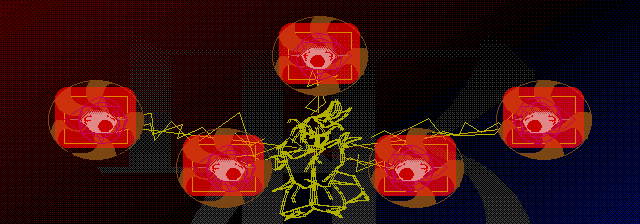
Phase 13: Runs through the parallel "pentagram
attack phases". The first five consist of the pentagram alternating its
spinning direction between clockwise and counterclockwise while firing
pellets from each of the five star corners. After that, the pentagram
slams itself into the player, before YuugenMagan loops back to phase
10 to spawn a new pentagram. On the next run through phase 13, the
pentagram grows larger and immediately slams itself into the player,
before starting a new pentagram attack phase cycle with another loop
back to phase 10.
Since the HP bar fills up in a phase with no collision detection,
YuugenMagan is immune to
📝 test/debug mode heap corruption. It's
generally impossible to get YuugenMagan's HP into negative numbers, with
collision detection being disabled every other phase, and all odd-numbered
phases ending immediately upon reaching their HP threshold.
All phases until the very last one have a timeout condition, independent
from YuugenMagan's current HP:
Phase 0: 331 frames
Phase 1: 1101 frames
Phases 2, 4, 6, 8, 10, and 12: 70 frames each
Phases 3 and 7: 5 iterations of the pattern, or
1845 frames each
Phase 5: 5 iterations of the pattern, or 2230
frames
Phase 9: The full duration of the sequence, or 491
frames
Phase 11: Until the pentagram reached its target
position, or 221 frames
This makes it possible to reach phase 13 without dealing a single point of
damage to YuugenMagan, after almost exactly 2½ minutes on any difficulty.
Your actual time will certainly be higher though, as you will have to
HARRY UP at least once during the attempt.
And let's be real, you're very likely to subsequently lose a
life.
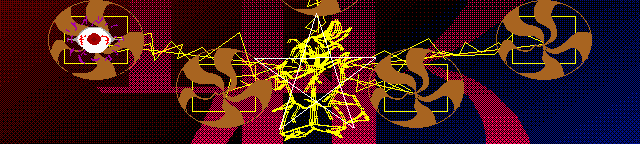
At a pixel-perfect 81×61 pixels, the Orb hitboxes are laid out rather
generously this time, reaching quite a bit outside the 64×48 eye sprites:
And that's about the only positive thing I can say about a position
calculation in this fight. Phase 0 already starts with the lasers being off
by 1 pixel from the center of the iris. Sure, 28 may be a nicer number to
add than 29, but the result won't be byte-aligned either way? This is
followed by the eastern laser's hitbox somehow being 24 pixels larger than
the others, stretching a rather unexpected 70 pixels compared to the 46 of
every other laser.
On a more hilarious note, the eye closing keyframe contains the following
(pseudo-)code, comprising the only real accidentally "unused" danmaku
subpattern in TH01:
// Did you mean ">= RANK_HARD"?
if(rank == RANK_HARD) {
	eye_north.fire_aimed_wide_5_spread();
	eye_southeast.fire_aimed_wide_5_spread();
	eye_southwest.fire_aimed_wide_5_spread();

	// Because this condition can never be true otherwise.
	// As a result, no pellets will be spawned on Lunatic mode.
	// (There is another Lunatic-exclusive subpattern later, though.)
	if(rank == RANK_LUNATIC) {
		eye_west.fire_aimed_wide_5_spread();
		eye_east.fire_aimed_wide_5_spread();
	}
}
Featuring the weirdly extended hitbox for the eastern laser, as well as
an initial Reimu position that points out the disparity between
byte-aligned rendering and the internal coordinates one final time.
After a few utility functions that look more like a quickly abandoned
refactoring attempt, we quickly get to the main attraction: YuugenMagan
combines the entire boss script and most of the pattern code into a single
2,634-instruction function, totaling 9,677 bytes inside
REIIDEN.EXE. For comparison, ReC98's version of this code
consists of at least 49 functions, excluding those I had to add to work
around ZUN's little inconsistencies, or the ones I added for stylistic
reasons.
In fact, this function is so large that Turbo C++ 4.0J refuses to generate
assembly output for it via the -S command-line option, aborting
with a Compiler table limit exceeded in function error.
Contrary to what the Borland C++ 4.0 User Guide suggests, this
instance of the error is not at all related to the number of function bodies
or any metric of algorithmic complexity, but is simply a result of the
compiler's internal text representation for a single function overflowing a
64 KiB memory segment. Merely shortening the names of enough identifiers
within the function can help to get that representation down below 64 KiB.
If you encounter this error during regular software development, you might
interpret it as the compiler's roundabout way of telling you that it inlined
way more function calls than you probably wanted to have inlined. Because
you definitely won't explicitly spell out such a long function
in newly-written code, right?
At least it wasn't the worst copy-pasting job in this
game; that trophy still goes to 📝 Elis. And
while the tracking code for adjusting an eye's sprite according to the
player's relative position is one of the main causes behind all the bloat,
it's also 100% consistent, and might have been an inlined class method in
ZUN's original code as well.
The clear highlight in this fight though? Almost no coordinate is
precisely calculated where you'd expect it to be. In particular, all
bullet spawn positions completely ignore the direction the eyes are facing
to:
Combining the bottom of the pupil with the exact horizontal
center of the sprite as a whole might sound like a good idea, but looks
especially wrong if the eye is facing right.Here it's the other way round: OK for a right-facing eye, really
wrong for a left-facing one.Dude, the eye is even supposed to track the laser in this
one!Hint: That's not the center of the playfield. At least the
pellets spawned from the corners are sort of correct, but with the corner
calculates precomputed, you could only get them wrong on
purpose.
Due to their effect on gameplay, these inaccuracies can't even be called
"bugs", and made me devise a new "quirk" category instead. More on that in
the TH01 100% blog post, though.
While we did see an accidentally unused bullet pattern earlier, I can
now say with certainty that there are no truly unused danmaku
patterns in TH01, i.e., pattern code that exists but is never called.
However, the code for YuugenMagan's phase 5 reveals another small piece of
danmaku design intention that never shows up within the parameters of
the original game.
By default, pellets are clipped when they fly past the top of the playfield,
which we can clearly observe for the first few pellets of this pattern.
Interestingly though, the second subpattern actually configures its pellets
to fall straight down from the top of the playfield instead. You never see
this happening in-game because ZUN limited that subpattern to a downwards
angle range of 0x73 or 162°, resulting in none of its pellets
ever getting close to the top of the playfield. If we extend that range to a
full 360° though, we can see how ZUN might have originally planned the
pattern to end:
YuugenMagan's phase 5 patterns on every difficulty, with the
second subpattern extended to reveal the different pellet behavior that
remained in the final game code. In the original game, the eyes would stop
spawning bullets on the marked frame.
If we also disregard everything else about YuugenMagan that fits the
upcoming definition of quirk, we're left with 6 "fixable" bugs, all
of which are a symptom of general blitting and unblitting laziness. Funnily
enough, they can all be demonstrated within a short 9-second part of the
fight, from the end of phase 9 up until the pentagram starts spinning in
phase 13:
General flickering whenever any sprite overlaps an eye. This is caused
by only reblitting each eye every 3 frames, and is an issue all throughout
the fight. You might have already spotted it in the videos above.
Each of the two lasers is unblitted and blitted individually instead of
each operation being done for both lasers together. Remember how
📝 ZUN unblits 32 horizontal pixels for every row of a line regardless of its width?
That's why the top part of the left, right-moving laser is never visible,
because it's blitted before the other laser is unblitted.
ZUN forgot to unblit the lasers when phase 9 ends. This footage was
recorded by pressing ↵ Return in test mode (game t or
game d), and it's probably impossible to achieve this during
actual gameplay without TAS techniques. You would have to deal the required
6 points of damage within 491 frames, with the eye being invincible during
240 of them. Simply shooting up an Orb with a horizontal velocity of 0 would
also only work a single time, as boss entities always repel the Orb with a
horizontal velocity of ±4.
The shrinking pentagram is unblitted after the eyes were blitted,
adding another guaranteed frame of flicker on top of the ones in 1). Like in
2), the blockiness of the holes is another result of unblitting 32 pixels
per row at a time.
Another missing unblitting call in a phase transition, as the pentagram
switches from its not quite correctly interpolated shrunk form to a regular
star polygon with a radius of 64 pixels. Indirectly caused by the massively
bloated coordinate calculation for the shrink animation being done
separately for the unblitting and blitting calls. Instead of, y'know, just
doing it once and storing the result in variables that can later be
reused.
The pentagram is not reblitted at all during the first 100 frames of
phase 13. During that rather long time, it's easily possible to remove
it from VRAM completely by covering its area with player shots. Or HARRY UP pellets.
Definitely an appropriate end for this game's entity blitting code.
I'm really looking forward to writing a
proper sprite system for the Anniversary Edition…
And just in case you were wondering about the hitboxes of these pentagrams
as they slam themselves into Reimu:
62 pixels on the X axis, centered around each corner point of the star, 16
pixels below, and extending infinitely far up. The latter part becomes
especially devious because the game always collision-detects
all 5 corners, regardless of whether they've already clipped through
the bottom of the playfield. The simultaneously occurring shape distortions
are simply a result of the line drawing function's rather poor
re-interpolation of any line that runs past the 640×400 VRAM boundaries;
📝 I described that in detail back when I debugged the shootout laser crash.
Ironically, using fixed-size hitboxes for a variable-sized pentagram means
that the larger one is easier to dodge.
The final puzzle in TH01's boss code comes
📝 once again in the form of weird hardware
palette changes. The 邪 kanji on the background
image goes through various colors throughout the fight, which ZUN
implemented by gradually incrementing and decrementing either a single one
or none of the color's three 4-bit components at the beginning of each
even-numbered phase. The resulting color sequence, however, doesn't
quite seem to follow these simple rules:
Phase 0: #DD5邪
Phase 2: #0DF邪
Phase 4: #F0F邪
Phase 6: #00F邪, but at the
end of the phase?!
Phase 8: #0FF邪, at the start
of the phase, #0F5邪, at the end!?
Phase 10: #FF5邪, at the start of
the phase, #F05邪, at the end
Second repetition of phase 12: #005邪
shortly after the start of the phase?!
Adding some debug output sheds light on what's going on there:
Since each iteration of phase 12 adds 63 to the red component, integer
overflow will cause the color to infinitely alternate between dark-blue
and red colors on every 2.03 iterations of the pentagram phase loop. The
65th iteration will therefore be the first one with a dark-blue color
for a third iteration in a row – just in case you manage to stall the
fight for that long.
Yup, ZUN had so much trust in the color clamping done by his hardware
palette functions that he did not clamp the increment operation on the
stage_palette itself. Therefore, the 邪
colors and even the timing of their changes from Phase 6 onwards are
"defined" by wildly incrementing color components beyond their intended
domain, so much that even the underlying signed 8-bit integer ends up
overflowing. Given that the decrement operation on the
stage_paletteis clamped though, this might be another
one of those accidents that ZUN deliberately left in the game,
📝 similar to the conclusion I reached with infinite bumper loops.
But guess what, that's also the last time we're going to encounter this type
of palette component domain quirk! Later games use master.lib's 8-bit
palette system, which keeps the comfort of using a single byte per
component, but shifts the actual hardware color into the top 4 bits, leaving
the bottom 4 bits for added precision during fades.
OK, but now we're done with TH01's bosses! 🎉That was the
8th PC-98 Touhou boss in total, leaving 23 to go.
With all the necessary research into these quirks going well into a fifth
push, I spent the remaining time in that one with transferring most of the
data between YuugenMagan and the upcoming rest of REIIDEN.EXE
into C land. This included the one piece of technical debt in TH01 we've
been carrying around since March 2015, as well as the final piece of the
ending sequence in FUUIN.EXE. Decompiling that executable's
main() function in a meaningful way requires pretty much all
remaining data from REIIDEN.EXE to also be moved into C land,
just in case you were wondering why we're stuck at 99.46% there.
On a more disappointing note, the static initialization code for the
📝 5 boss entity slots ultimately revealed why
YuugenMagan's code is as bloated and redundant as it is: The 5 slots really
are 5 distinct variables rather than a single 5-element array. That's why
ZUN explicitly spells out all 5 eyes every time, because the array he could
have just looped over simply didn't exist. 😕 And while these slot variables
are stored in a contiguous area of memory that I could just have
taken the address of and then indexed it as if it were an array, I
didn't want to annoy future port authors with what would technically be
out-of-bounds array accesses for purely stylistic reasons. At least it
wasn't that big of a deal to rewrite all boss code to use these distinct
variables, although I certainly had to get a bit creative with Elis.
Next up: Finding out how many points we got in totle, and hoping that ZUN
didn't hide more unexpected complexities in the remaining 45 functions of
this game. If you have to spare, there are two ways
in which that amount of money would help right now:
I'm expecting another subscription transaction
from Yanga before the 15th, which would leave to
round out one final TH01 RE push. With that, there'd be a total of 5 left in
the backlog, which should be enough to get the rest of this game done.
I really need to address the performance and usability issues
with all the small videos in this blog. Just look at the video immediately
above, where I disabled the controls because they would cover the debug text
at the bottom… Edit (2022-10-31):… which no longer is an
issue with our 📝 custom video player.
I already reserved this month's anonymous contribution for this work, so it would take another to be turned into a full push.
Oh look, it's another rather short and straightforward boss with a rather
small number of bugs and quirks. Yup, contrary to the character's
popularity, Mima's premiere is really not all that special in terms of code,
and continues the trend established with
📝 Kikuri and
📝 SinGyoku. I've already covered
📝 the initial sprite-related bugs last November,
so this post focuses on the main code of the fight itself. The overview:
The TH01 Mima fight consists of 3 phases, with phases 1 and 3 each
corresponding to one half of the 12-HP bar.
📝 Just like with SinGyoku, the distinction
between the red-white and red parts is purely visual once again, and doesn't
reflect anything about the boss script. As usual, all of the phases have to
be completed in order.
Phases 1 and 3 cycle through 4 danmaku patterns each, for a total of 8.
The cycles always start on a fixed pattern.
3 of the patterns in each phase feature rotating white squares, thus
introducing a new sprite in need of being unblitted.
Phase 1 additionally features the "hop pattern" as the last one in its
cycle. This is the only pattern where Mima leaves the seal in the center of
the playfield to hop from one edge of the playfield towards the other, while
also moving slightly higher up on the Y axis, and staying on the final
position for the next pattern cycle. For the first time, Mima selects a
random starting edge, which is then alternated on successive cycles.
Since the square entities are local to the respective pattern function,
Phase 1 can only end once the current pattern is done, even if Mima's HP are
already below 6. This makes Mima susceptible to the
📝 test/debug mode HP bar heap corruption bug.
Phase 2 simply consists of a spread-in teleport back to Mima's initial
position in the center of the playfield. This would only have been strictly
necessary if phase 1 ended on the hop pattern, but is done regardless of the
previous pattern, and does provide a nice visual separation between the two
main phases.
That's it – nothing special in Phase 3.
And there aren't even any weird hitboxes this time. What is maybe
special about Mima, however, is how there's something to cover about all of
her patterns. Since this is TH01, it's won't surprise anyone that the
rotating square patterns are one giant copy-pasta of unblitting, updating,
and rendering code. At least ZUN placed the core polar→Cartesian
transformation in a separate function for creating regular polygons
with an arbitrary number of sides, which might hint toward some more varied
shapes having been planned at one point?
5 of the 6 patterns even follow the exact same steps during square update
frames:
Calculate square corner coordinates
Unblit the square
Update the square angle and radius
Use the square corner coordinates for spawning pellets or missiles
Recalculate square corner coordinates
Render the square
Notice something? Bullets are spawned before the corner coordinates
are updated. That's why their initial positions seem to be a bit off – they
are spawned exactly in the corners of the square, it's just that it's
the square from 8 frames ago.
Mima's first pattern on Normal difficulty.
Once ZUN reached the final laser pattern though, he must have noticed that
there's something wrong there… or maybe he just wanted to fire those
lasers independently from the square unblit/update/render timer for a
change. Spending an additional 16 bytes of the data segment for conveniently
remembering the square corner coordinates across frames was definitely a
decent investment.
When Mima isn't shooting bullets from the corners of a square or hopping
across the playfield, she's raising flame pillars from the bottom of the playfield within very specifically calculated
random ranges… which are then rendered at byte-aligned VRAM positions, while
collision detection still uses their actual pixel position. Since I don't
want to sound like a broken record all too much, I'll just direct you to
📝 Kikuri, where we've seen the exact same issue with the teardrop ripple sprites.
The conclusions are identical as well.
Mima's flame pillar pattern. This video was recorded on a particularly
unlucky seed that resulted in great disparities between a pillar's
internal X coordinate and its byte-aligned on-screen appearance, leading
to lots of right-shifted hitboxes.
Also note how the change from the meteor animation to the three-arm 🚫
casting sprite doesn't unblit the meteor, and leaves that job to
any sprite that happens to fly over those pixels.
However, I'd say that the saddest part about this pattern is how choppy it
is, with the circle/pillar entities updating and rendering at a meager 7
FPS. Why go that low on purpose when you can just make the game render ✨
smoothly ✨ instead?
So smooth it's almost uncanny.
The reason quickly becomes obvious: With TH01's lack of optimization, going
for the full 56.4 FPS would have significantly slowed down the game on its
intended 33 MHz CPUs, requiring more than cheap surface-level ASM
optimization for a stable frame rate. That might very well have been ZUN's
reason for only ever rendering one circle per frame to VRAM, and designing
the pattern with these time offsets in mind. It's always been typical for
PC-98 developers to target the lowest-spec models that could possibly still
run a game, and implementing dynamic frame rates into such an engine-less
game is nothing I would wish on anybody. And it's not like TH01 is
particularly unique in its choppiness anyway; low frame rates are actually a
rather typical part of the PC-98 game aesthetic.
The final piece of weirdness in this fight can be found in phase 1's hop
pattern, and specifically its palette manipulation. Just from looking at the
pattern code itself, each of the 4 hops is supposed to darken the hardware
palette by subtracting #444 from every color. At the last hop,
every color should have therefore been reduced to a pitch-black
#000, leaving the player completely blind to the movement of
the chasing pellets for 30 frames and making the pattern quite ghostly
indeed. However, that's not what we see in the actual game:
Nothing in the pattern's code would cause the hardware palette to get
brighter before the end of the pattern, and yet…
The expected version doesn't look all too unfair, even on Lunatic…
well, at least at the default rank pellet speed shown in this
video. At maximum pellet speed, it is in fact rather brutal.
Looking at the frame counter, it appears that something outside the
pattern resets the palette every 40 frames. The only known constant with a
value of 40 would be the invincibility frames after hitting a boss with the
Orb, but we're not hitting Mima here…
But as it turns out, that's exactly where the palette reset comes from: The
hop animation darkens the hardware palette directly, while the
📝 infamous 12-parameter boss collision handler function
unconditionally resets the hardware palette to the "default boss palette"
every 40 frames, regardless of whether the boss was hit or not. I'd classify
this as a bug: That function has no business doing periodic hardware palette
resets outside the invincibility flash effect, and it completely defies
common sense that it does.
That explains one unexpected palette change, but could this function
possibly also explain the other infamous one, namely, the temporary green
discoloration in the Konngara fight? That glitch comes down to how the game
actually uses two global "default" palettes: a default boss
palette for undoing the invincibility flash effect, and a default
stage palette for returning the colors back to normal at the end of
the bomb animation or when leaving the Pause menu. And sure enough, the
stage palette is the one with the green color, while the boss
palette contains the intended colors used throughout the fight. Sending the
latter palette to the graphics chip every 40 frames is what corrects
the discoloration, which would otherwise be permanent.
The green color comes from BOSS7_D1.GRP, the scrolling
background of the entrance animation. That's what turns this into a clear
bug: The stage palette is only set a single time in the entire fight,
at the beginning of the entrance animation, to the palette of this image.
Apart from consistency reasons, it doesn't even make sense to set the stage
palette there, as you can't enter the Pause menu or bomb during a blocking
animation function.
And just 3 lines of code later, ZUN loads BOSS8_A1.GRP, the
main background image of the fight. Moving the stage palette assignment
there would have easily prevented the discoloration.
But yeah, as you can tell, palette manipulation is complete jank in this
game. Why differentiate between a stage and a boss palette to begin with?
The blocking Pause menu function could have easily copied the original
palette to a local variable before darkening it, and then restored it after
closing the menu. It's not so easy for bombs as the intended palette could
change between the start and end of the animation, but the code could have
still been simplified a lot if there was just one global "default palette"
variable instead of two. Heck, even the other bosses who manipulate their
palettes correctly only do so because they manually synchronize the two
after every change. The proper defense against bugs that result from wild
mutation of global state is to get rid of global state, and not to put up
safety nets hidden in the middle of existing effect code.
The easiest way of reproducing the green discoloration bug in
the TH01 Konngara fight, timed to show the maximum amount of time the
discoloration can possibly last.
In any case, that's Mima done! 7th PC-98 Touhou boss fully
decompiled, 24 bosses remaining, and 59 functions left in all of TH01.
In other thrilling news, my call for secondary funding priorities in new
TH01 contributions has given us three different priorities so far. This
raises an interesting question though: Which of these contributions should I
now put towards TH01 immediately, and which ones should I leave in the
backlog for the time being? Since I've never liked deciding on priorities,
let's turn this into a popularity contest instead: The contributions with
the least popular secondary priorities will go towards TH01 first, giving
the most popular priorities a higher chance to still be left over after TH01
is done. As of this delivery, we'd have the following popularity order:
TH05 (1.67 pushes), from T0182
Seihou (1 push), from T0184
TH03 (0.67 pushes), from T0146
Which means that T0146 will be consumed for TH01 next, followed by T0184 and
then T0182. I only assign transactions immediately before a delivery though,
so you all still have the chance to change up these priorities before the
next one.
Next up: The final boss of TH01 decompilation, YuugenMagan… if the current
or newly incoming TH01 funds happen to be enough to cover the entire fight.
If they don't turn out to be, I will have to pass the time with some Seihou
work instead, missing the TH01 anniversary deadline as a result.Edit (2022-07-18): Thanks to Yanga for
securing the funding for YuugenMagan after all! That fight will feature
slightly more than half of all remaining code in TH01's
REIIDEN.EXE and the single biggest function in all of PC-98
Touhou, let's go!
OK, TH01 missile bullets. Can we maybe have a well-behaved entity type,
without any weirdness? Just once?
Ehh, kinda. Apart from another 150 bytes wasted on unused structure members,
this code is indeed more on the low end in terms of overall jank. It does
become very obvious why dodging these missiles in the YuugenMagan, Mima, and
Elis fights feels so awful though: An unfair 46×46 pixel hitbox around
Reimu's center pixel, combined with the comeback of
📝 interlaced rendering, this time in every
stage. ZUN probably did this because missiles are the only 16×16 sprite in
TH01 that is blitted to unaligned X positions, which effectively ends up
touching a 32×16 area of VRAM per sprite.
But even if we assume VRAM writes to be the bottleneck here, it would
have been totally possible to render every missile in every frame at roughly
the same amount of CPU time that the original game uses for interlaced
rendering:
Note that all missile sprites only use two colors, white and green.
Instead of naively going with the usual four bitplanes, extract the
pixels drawn in each of the two used colors into their own bitplanes.
master.lib calls this the "tiny format".
Use the GRCG to draw these two bitplanes in the intended white and green
colors, halving the amount of VRAM writes compared to the original
function.
(Not using the .PTN format would have also avoided the inconsistency of
storing the missile sprites in boss-specific sprite slots.)
That's an optimization that would have significantly benefitted the game, in
contrast to all of the fake ones
introduced in later games. Then again, this optimization is
actually something that the later games do, and it might have in fact been
necessary to achieve their higher bullet counts without significant
slowdown.
After some effectively unused Mima sprite effect code that is so broken that
it's impossible to make sense out of it, we get to the final feature I
wanted to cover for all bosses in parallel before returning to Sariel: The
separate sprite background storage for moving or animated boss sprites in
the Mima, Elis, and Sariel fights. But, uh… why is this necessary to begin
with? Doesn't TH01 already reserve the other VRAM page for backgrounds?
Well, these sprites are quite big, and ZUN didn't want to blit them from
main memory on every frame. After all, TH01 and TH02 had a minimum required
clock speed of 33 MHz, half of the speed required for the later three games.
So, he simply blitted these boss sprites to both VRAM pages, leading
the usual unblitting calls to only remove the other sprites on top of the
boss. However, these bosses themselves want to move across the screen…
and this makes it necessary to save the stage background behind them
in some other way.
Enter .PTN, and its functions to capture a 16×16 or 32×32 square from VRAM
into a sprite slot. No problem with that approach in theory, as the size of
all these bigger sprites is a multiple of 32×32; splitting a larger sprite
into these smaller 32×32 chunks makes the code look just a little bit clumsy
(and, of course, slower).
But somewhere during the development of Mima's fight, ZUN apparently forgot
that those sprite backgrounds existed. And once Mima's 🚫 casting sprite is
blitted on top of her regular sprite, using just regular sprite
transparency, she ends up with her infamous third arm:
Ironically, there's an unused code path in Mima's unblit function where ZUN
assumes a height of 48 pixels for Mima's animation sprites rather than the
actual 64. This leads to even clumsier .PTN function calls for the bottom
128×16 pixels… Failing to unblit the bottom 16 pixels would have also
yielded that third arm, although it wouldn't have looked as natural. Still
wouldn't say that it was intentional; maybe this casting sprite was just
added pretty late in the game's development?
So, mission accomplished, Sariel unblocked… at 2¼ pushes. That's quite some time left for some smaller stage initialization
code, which bundles a bunch of random function calls in places where they
logically really don't belong. The stage opening animation then adds a bunch
of VRAM inter-page copies that are not only redundant but can't even be
understood without knowing the hidden internal state of the last VRAM page
accessed by previous ZUN code…
In better news though: Turbo C++ 4.0 really doesn't seem to have any
complexity limit on inlining arithmetic expressions, as long as they only
operate on compile-time constants. That's how we get macro-free,
compile-time Shift-JIS to JIS X 0208 conversion of the individual code
points in the 東方★靈異伝 string, in a compiler from 1994. As long as you
don't store any intermediate results in variables, that is…
But wait, there's more! With still ¼ of a push left, I also went for the
boss defeat animation, which includes the route selection after the SinGyoku
fight.
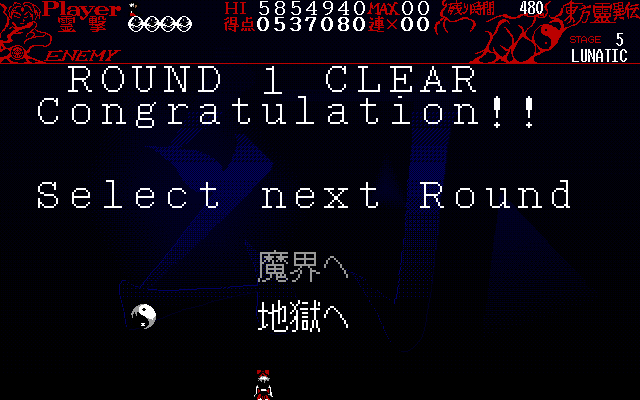
As in all other instances, the 2× scaled font is accomplished by first
rendering the text at regular 1× resolution to the other, invisible VRAM
page, and then scaled from there to the visible one. However, the route
selection is unique in that its scaled text is both drawn transparently on
top of the stage background (not onto a black one), and can also change
colors depending on the selection. It would have been no problem to unblit
and reblit the text by rendering the 1× version to a position on the
invisible VRAM page that isn't covered by the 2× version on the visible one,
but ZUN (needlessly) clears the invisible page before rendering any text.
Instead, he assigned a separate VRAM color for both
the 魔界 and 地獄 options, and only changed the palette value for
these colors to white or gray, depending on the correct selection. This is
another one of the
📝 rare cases where TH01 demonstrates good use of PC-98 hardware,
as the 魔界へ and 地獄へ strings don't need to be reblitted during the selection process, only the Orb "cursor" does.
Then, why does this still not count as good-code? When
changing palette colors, you kinda need to be aware of everything
else that can possibly be on screen, which colors are used there, and which
aren't and can therefore be used for such an effect without affecting other
sprites. In this case, well… hover over the image below, and notice how
Reimu's hair and the bomb sprites in the HUD light up when Makai is
selected:
This push did end on a high note though, with the generic, non-SinGyoku
version of the defeat animation being an easily parametrizable copy. And
that's how you decompile another 2.58% of TH01 in just slightly over three
pushes.
Now, we're not only ready to decompile Sariel, but also Kikuri, Elis, and
SinGyoku without needing any more detours into non-boss code. Thanks to the
current TH01 funding subscriptions, I can plan to cover most, if not all, of
Sariel in a single push series, but the currently 3 pending pushes probably
won't suffice for Sariel's 8.10% of all remaining code in TH01. We've got
quite a lot of not specifically TH01-related funds in the backlog to pass
the time though.
Due to recent developments, it actually makes quite a lot of sense to take a
break from TH01: spaztron64 has
managed what every Touhou download site so far has failed to do: Bundling
all 5 game onto a single .HDI together with pre-configured PC-98
emulators and a nice boot menu, and hosting the resulting package on a
proper website. While this first release is already quite good (and much
better than my attempt from 2014), there is still a bit of room for
improvement to be gained from specific ReC98 research. Next up,
therefore:
Researching how TH04 and TH05 use EMS memory, together with the cause
behind TH04's crash in Stage 5 when playing as Reimu without an EMS driver
loaded, and
reverse-engineering TH03's score data file format
(YUME.NEM), which hopefully also comes with a way of building a
file that unlocks all characters without any high scores.
Last part of TH01's main graphics function segment, and we've got even
more code that alternates between being boring and being slightly weird.
But at least, "boring" also meant "consistent" for once. And
so progress continued to be as fast as expected from the last TH01 pushes,
yielding 3.3% in TH01 RE%, and 1% in overall RE%, within a single day.
There even was enough time to decompile another full code segment, which
bundles all the hardware initialization and cleanup calls into single
functions to be run when starting and exiting the game. Which might be
interesting for at least one person, I guess
But seriously, trying to access page 2 on a system with only page 0 and 1?
Had to get out my real PC-98 to double-check that I wasn't missing
anything here, since every emulator only looks at the bottom bit of the
page number. But real hardware seems to do the same, and there really is
nothing special to it semantically, being equivalent to page 0. 🤷
Next up in TH01, we'll have some file format code!
So, the thing that made me so excited about TH01 were all those bulky C
reimplementations of master.lib functions. Identical copies in all three
executables, trivial to figure out and decompile, removing tons of
instructions, and providing a foundation for large parts of the game
later. The first set of functions near the end of that shared code segment
deals with color palette handling, and master.lib's resident palette
structure in particular. (No relation to the game's
resident structure.) Which directly starts us out with pretty much
all the decompilation difficulties imaginable:
iteration over internal DOS structures via segment pointers – Turbo
C++ doesn't support a lot of arithmetic on those, requiring tons of casts
to make it work
calls to a far function near the beginning of a segment
from a function near the end of a segment – these are undecompilable until
we've decompiled both functions (and thus, the majority of the segment),
and need to be spelled out in ASM for the time being. And if the caller
then stores some of the involved variables in registers, there's no
way around the ugliest of workarounds, spelling out opcode bytes…
surprising color format inconsistencies – apparently, GRB (rather than
RGB) is some sort of wider standard in PC-98 inter-process communication,
because it matches the order of the hardware's palette register ports?
(0AAh = green,
0ACh = red,
0AEh = blue)? Yet the
game's actual palette still uses RGB…
And as it turns out, the game doesn't even use the resident palette
feature. Which adds yet another set of functions to the, uh, learning
experience that ZUN must have chosen this game to be. I wouldn't be
surprised if we manage to uncover actual scrapped beta game content later
on, among all the unused code that's bound to still be in there.
At least decompilation should get easier for the next few TH01 pushes now…
right?





 Therefore, the 邪
colors and even the timing of their changes from Phase 6 onwards are
"defined" by wildly incrementing color components beyond their intended
domain, so much that even the underlying signed 8-bit integer ends up
overflowing. Given that the decrement operation on the
Therefore, the 邪
colors and even the timing of their changes from Phase 6 onwards are
"defined" by wildly incrementing color components beyond their intended
domain, so much that even the underlying signed 8-bit integer ends up
overflowing. Given that the decrement operation on the
 from the bottom of the playfield within very specifically calculated
random ranges… which are then rendered at byte-aligned VRAM positions, while
collision detection still uses their actual pixel position. Since I don't
want to sound like a broken record all too much, I'll just direct you to
from the bottom of the playfield within very specifically calculated
random ranges… which are then rendered at byte-aligned VRAM positions, while
collision detection still uses their actual pixel position. Since I don't
want to sound like a broken record all too much, I'll just direct you to